Tuesday, December 7, 2010

The Best Business Advice In 140 Characters Or Less

The Best Business Advice In 140 Characters Or Less: "

steve martin tweet

The beauty of Twitter is that all its content is succint. It makes for great skimming, link-sharing, and even inspiring.


We scoured Twitter to find favorite tweets from the best in business. Our hit list included venture capitalists Fred Wilson and Bijan Sabet, entrepreneurs like Mark Cuban and Evan Williams, and media companies such as Inc and Entrepreneur Magazine.


Here are the 20 most inspiring and  insightful tweets we could find.

Check out the 20 top tweets from business leaders >>

Join the conversation about this story »

See Also:


"

Time bridge – Online meeting scheduler

Time bridge – Online meeting scheduler: "

Time bridge is a product that helps you to co-ordinate your time with others and manage meetings and get together without any hassle. You can use a single email and organize a weekly meeting with your staffs or with single person with the help of Time Bridge.


This will take into account everyone’s calendar and update the best time automatically. Time Bridge works proposal up to five times that is best for you by considering and juggling the schedule of everyone involved and comes up the best time for everyone to attend a meeting.


Timebridge


Features of Time bridge


  1. Three Powerful Ways To Share Your Availability : Time Bridge is a device that helps to make it a lot simpler to meet up with anyone and everyone by sharing schedules with individual people. Time Bridge also helps to connect groups and make a team and also allows you to announce the times you are available to the members of your group. The special attributes of this feature are that Time bridge will help you to share your availability with people notwithstanding in what calendar system they are. It also helps you to arrange team meetings in a most convenient way.

  2. Not letting Late Comers Slow you Down : It is always a pain to heard attendees to the conference room and constantly remind them of upcoming meetings. With the help of Time Bridge this problem will be overcome as Time Bridge sends automatic reminders of email and SMS to the people who are supposed to attend the meetings. This will begin the countdown to the meeting by generating SMS and email reminders and also round up the latecomers which you had to do otherwise.

  3. Ways of Staying on Topic and on Time Every Time With The Help of Time Bridge : Time Bridge helps you to keep your meeting on track by making you stick to the agenda, capture outcome and leave the meeting ready for action. You can use Time Bridge to share agenda and monitor the progress of the meeting with the help of iPhone application of Time Bridge.

  4. The Specifications Requirements to Use Time Bridge : The mandatory requirements for using Time Bridge are web browser and email account. Time Bridge offers optional functionality for Google calendar, Outlook, iPhone and SMS messaging.


Pros And Cons Of Time Bridge


Pros of Time Bridge :


  1. Time Bridge is for business professionals who have to attend and organize numerous meetings and finds it difficult to co-ordinate it all.

  2. Time Bridge will help such people to figure out when to meet with specific groups of people even the ones who do not use the in-house calendar.

  3. Time Bridge will conference the call and maintains Web meeting functionality along with keeping the meeting on track.


Cons of Time Bridge :


  1. Time Bridge has limited usefulness and acts as a one-trick pony. It offers value ads only with the Plus accounts.

  2. The web conferencing of Time Bridge is weak as compared to other such applications. The features offered are limited.


However in spite of these drawbacks Time Bridge is one of the best applications for time handling.


Related posts:
  1. Tungle.me – Online personal scheduling tool

  2. Appointy – web-based free Appointment Scheduler

  3. WebCalendar – PHP-based online calendar tool

  4. Glasscubes – online collaboration and project management tool for Google Apps

  5. Collaber – multi platform online project management and collaboration tool

  6. Scriblink – free online digital collaborative whiteboard

"

Monday, December 6, 2010

When’s the Best Time to Publish Blog Posts?

When’s the Best Time to Publish Blog Posts?: "

This guest post is by HubSpot’s social media scientist, Dan Zarrella.


Of all the data analysis that I’ve done, day-of-week and time-of-day data has been consistently the most popular. So in preparation for my upcoming webinar, titled Science of Blogging, I decided to combine all of my existing data on timing with my new research into one master post on the subject.
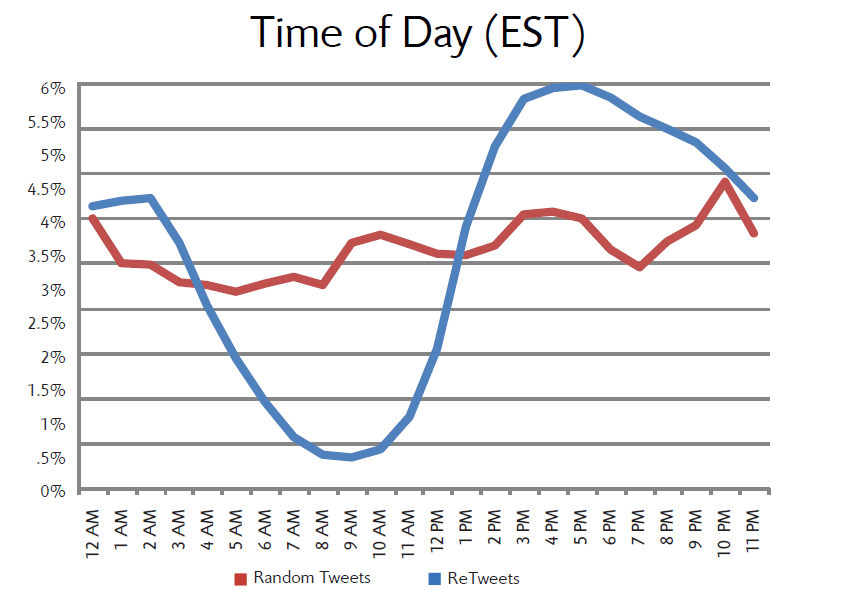


The first time I looked at blog post timing was when I was analyzing retweets. I found that retweets exhibit a strong diurnal pattern, in that they’re more common during the day and less so at night. I noticed that retweet activity tended to peak around 4pm EST, suggesting that this might be the best time to tweet a blog post for maximum potential retweet reach.
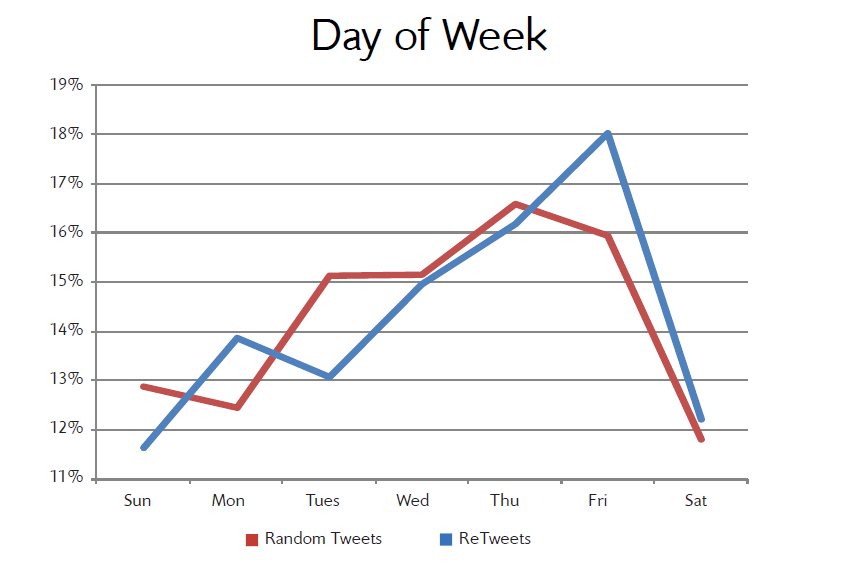


When I looked at retweet activity over the days of the week, I saw that they peaked later in the work week, specifically on Friday.


Since I first published this graph, the most frequently cited piece of this research has been the idea that Friday at 4pm is the most retweetable time of the week. While your niche maybe different, this data was based on analysis of nearly 100 million retweets, so in aggregate, Friday at 4pm is indeed the most retweetable time of the week.
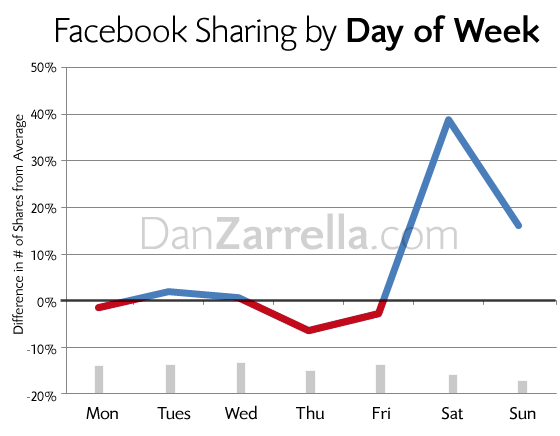


Moving on from retweets, I started studying Facebook sharing and discovered some things that surprised me about timing there, too.


First, while major news sites and blogs publish articles during the work week, articles that are published on Saturday and Sunday tend to be shared on Facebook more than those published during the week. Perhaps one reason for this is that (as Wired reported), more than 50% of American companies block Facebook at work.
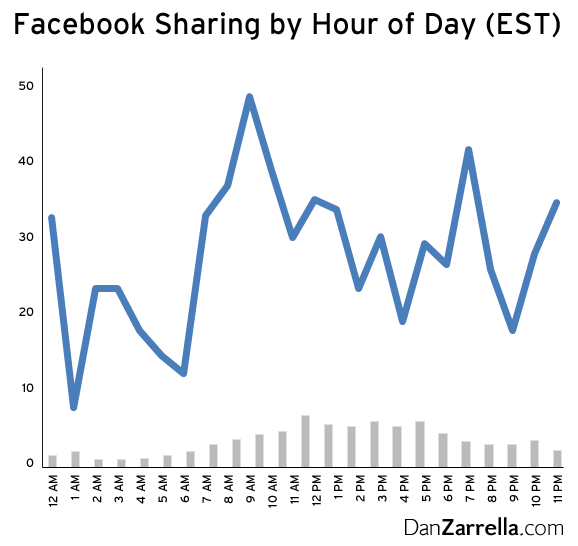


Next, I looked at the effect that the time articles were published had on the number of times they were shared on Facebook. I found that while there is a fair amount of variation, articles published in the morning, around 9a.m. EST, tended to be shared more on Facebook than articles published at other times of the day.


Looking back at these four data points, it may seem that they’re contradictory, but thinking through them a bit more, we can see that they is not necessarily so. Both day-of-week charts tell us that we should experiment with publishing articles later in the week—on Friday and Saturday specifically.


And by publishing posts early in the day, but tweeting them later in the afternoon, we can stimulate both Facebook shares and retweets.
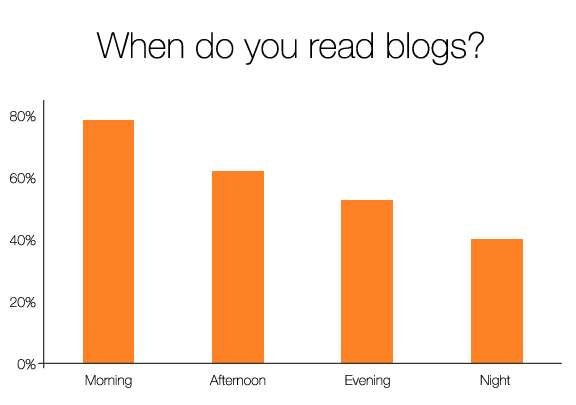

I recently did a survey of over 1,400 blog readers and I asked them what time-of-day they read blogs. Morning was the most popular, followed in decreasing popularity by the rest of the day. Most respondents reported reading blogs at more than one time, so this piece of data reinforces my suggestion to publish early in the morning.
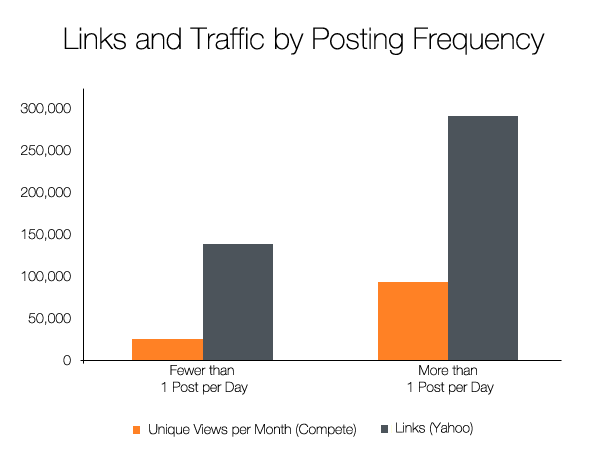

The best timing advice, however, may actually be around frequency. Last week, I analyzed 1000 of the most popular blogs on the web, according to Technorati. I compared their posting frequency with the number of incoming links and visitors they had attracted (according to Yahoo and Compete).


I found that among very popular blogs, publishing multiple times per day led to a huge increase in a blog’s success. This tells us that rather than focusing one perfect day or time, we should aim to publish at many times, and on many days.


Have you experimented with post timing and tweeting? What has your experience shown about the best times of day or week to reach your readers?


Dan Zarrella is HubSpot’s social media scientist. This post contains data from his upcoming webinar The Science of Blogging, taking place on December 9th.


Post from: ProBlogger Blog Tips

-1.gif


When’s the Best Time to Publish Blog Posts?


"

Thursday, December 2, 2010

Who spies on your browsing history?

Who spies on your browsing history?: "


We've written before about the security vulnerability that allows websites to sniff your browsing history. A paper from UC San Diego computer science department researchers, 'An Empirical Study of Privacy-Violating Information Flows in JavaScript Web Applications,' surveys which websites use this invasive technique against their users. YouPorn tops the list, but PerezHilton, Technorati, TheSun.co.uk, and Wired are also spying on their users' browsing habits by exploiting this vulnerability.


So I checked in with Interclick. Interclick explained that it deployed the script on websites around the Web over a limited period, from March to October, to test the quality of data sets it had purchased. 'Interclick purchases anonymous audience data from several vendors for the purpose of targeting advertising campaigns. Consequently, it has a number of quality control measures in place to understand the quality and effectiveness of this data. The code observed in the paper was a quality measure being tested,' said Interclick in a statement to me.


I asked Interclick to explain and got some interesting insight into how the data purchasing market works. Interclick buys user targeting data on websites such as BlueKai, Bizo, AlmondNet, Datalogix and Exelate. The data sets supposedly represent a group of particular users, like Sports Enthusiasts or Industrial Equipment Shoppers. But Interclick needs to know that it's getting what it paid for, so that its ads are more effective, so it has a series of quality control measures. The researchers happened upon one of those quality control tests.


Firefox's 'Private Browsing' facility appears to be proof against this attack, for what it's worth.


History Sniffing: How YouPorn Checks What Other Porn Sites You've Visited and Ad Networks Test The Quality of Their Data

(via JWZ)


(Image: What the Internet Knows About You vs my browser history)


"

Wednesday, November 24, 2010

This Week in Web Apps

This Week in Web Apps: "

This week has been pretty busy for both bigger and smaller companies in the online universe. Google trying the hardest among the lot, working towards making internet a better place as always (all the while collecting & mining data). Bit.ly pulled one more rabbit out of their hat, Mozilla showcased its financial might and Meebo jumped on the check-in bandwagon.


At the end of a week, a few times per month, we’ll bring you some of the best web app news and updates. App developers, this is a great time to familiarize yourselves with our contact form to submit your news or tips.


Read on after the break for some of this weeks best web app news and updates.


20 Things I Learned


20 Things I Learned

20 Things I Learned


This month marks the twentieth anniversary of Tim Berners-Lee publishing a proposal about the World Wide Web. Imagine where things stand today! Pretty amazing isn’t it! Still a lot of us have a bunch of question as to how browsers and the web actually work? What is HTML5—or HTML for that matter? What do terms like “cookies” or “cloud computing” even mean? More practically, how can we keep ourselves safe from security threats like viruses when we’re online?


Google has collaborated with Christoph Niemann and have produced a fantastic web app that educates newbies on all things internet.


Bit.ly Bundles


Bit.ly Bundles

Bit.ly Bundles


For a company that focuses on making URLs short, Bit.ly always has bigger goals. If they did not get a kudos for running a pseudo domain name registry, they deserve it alteast now with their recent announcement. Now you can bundle up all your tiny URL links into one tiny little URL. Every link you add to a bundle will include a rich media preview, a bit.ly click count, and can be customized with a title and description. Try it out !


Google Product Search


Google Product Search

Google Product Search


The holidays are coming and so is the gifting season! Every year retailers start the holiday shopping season earlier and earlier and it’s a real mess when trying to find the best bargain out there. To help all the shopaholics, Google has just revamped its Product Search feature. They’ve partnered with 70 large retailers and now if you’re looking online to find that new gadget you’ve been wanting, you can click on the “nearby stores” link to see where it’s in stock nearby.


Also, when you search for a category of products, the new popular products feature helps you get started by showing you the products from the same category that other people are viewing online. As long as they don’t show the name and addresses of people along with results, I am happy!


Meebo Check Ins


Meebo Check Ins

Meebo Check Ins


These days, everybody wants to be in the check-in game. Poor Foursquare! Now Meebo has gone one step further and allows you to check into the websites you visit. Find a good story? Link to the page. Add a comment. Click Check in.


When you check in to a site, it is added to your Meebo Profile – that’s right: Meebo users can now have their own profile pages that highlight their favorite sites. Link your Facebook or Twitter accounts to keep your friends up to date on your Meebo activity.


Scribd Stats


Scribd Stats

Scribd Stats


Scribd is the YouTube for documents. Being an awesome web app is never enough for them and they constantly keep improving their product. Their latest new feature allows you to pull comprehensive statistics on your documents shared in Scribd ala. Google Analytics.


From your “My Stats” page you have access to the dashboard of information, including which of your docs people are reading and sharing most, how people are finding them, which docs they’re spending the most time on and much more.


The State of Mozilla


State of Mozilla

State of Mozilla


Being an ardent fan of Firefox, I’ve been super pissed at them for pushing back Firefox 4 into 2011. Even though Google Chrome is eating into Mozilla’s market-share, things are going very well for them on the financial front, which is evident from the State of Mozilla report. For 2009, Mozilla reported revenues of $104 million, up 34% from 2008. That’s a really cool number considering the fact that all their products are free. They do this once they’ve filed their audited financial statements for the previous year, so these numbers are for 2009. Go Mozilla!


Share Your Thoughts!


What news from the app universe grabbed your attention in the past few days? Share your thoughts and opinions in the comments section. Thanks!


"

Tuesday, November 16, 2010

The 30 Startups People Care About The Most

The 30 Startups People Care About The Most: "


Yesterday I wrote about a service called StartupFollower, which allows users to sign up for email notifications when TechCrunch writes about their favorite startups.  Today, after receiving 738 signups and 3138 total company follows post launch, founder Tim Suzman sent us the StartupFollower follow distribution list. While informal, the list gives a rough idea of which companies our readers want to receive news about, based on subscriptions.


Prior to StartupFollower, we knew that 23% of you wanted to read more news about companies, but we had no concrete idea which ones. Now we know that Facebook, Twitter, Foursquare, Quora, Google, Groupon, Apple, RockMelt, Zynga and TechCrunch are on your top ten list, or at least they were yesterday.


And, allowing for a disproportionate following of startups that were recently on TC (eh hem Rockmelt) the list jives pretty well with the amount we cover rockstars like Facebook and Twitter, for example.


Likewise, we and other tech publications often get dinged in the comments for covering biggies like Apple too much, but how could we ignore the fact that Microsoft is below Box.net in the amount of people who want to subscribe to MSFT related news?


Other notable bottom feeders? IBM, Craigslist and Diaspora. But hey at least they made the list, which is now up to 1387 unique companies followed. Feel free to include any others you think should be on here in the comments.


Note: Because technically the definition of a startup is “a fledgling enterprise,” it’s pretty debatable which companies on this list are still in the startup stage. Even we’re not that sure, behemoth Facebook won last year’s Crunchie for “Best Overall Startup,” no joke.


Says creator Suzman on StartupFollower’s loose categorization, I figured the most common use case would be to follow startups, but obviously people want to be able to follow Google too.”


You can check out the full list here.


"